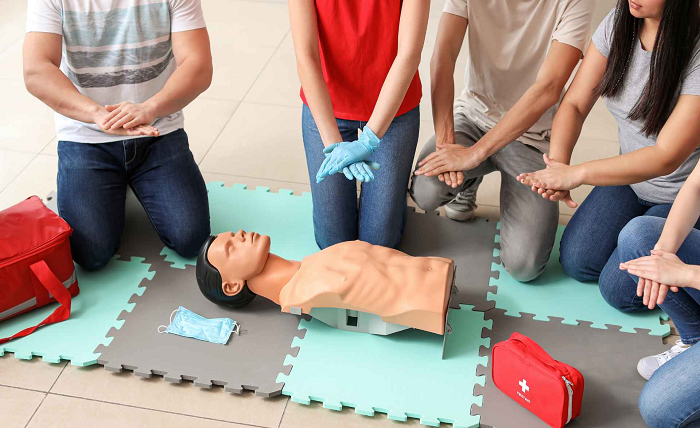
The moment someone collapses in front of you, the fear is rarely about not caring, it’s about not knowing what your hands are supposed to do. Coast2Coast First Aid, a Top 3 Canadian Red Cross Training Partner, has spent over a decade watching that exact freeze happen in classrooms before students learn to push through it. Toronto renters sharing a house in Parkdale, students commuting in from Scarborough for a night class, or a group of roommates near George Brown College’s waterfront campus all show up to their first session for the same reason: they’ve imagined the moment something goes wrong and realized they wouldn’t know what to do. Taking online First Aid and CPR training in Toronto is less about the certificate and more about closing that specific gap between caring and being able to act.
Key Takeaways
- Freezing up in an emergency isn’t a character flaw, it’s an untrained nervous system doing exactly what untrained nervous systems do under sudden stress.
- CPR and first aid skills follow the same learning pattern as any physical skill: repetition builds automatic response, reading about it does not.
- Blended courses let the theory portion happen online, on a personal schedule, before a single in-person session covers the hands-on practice.
- Coast2Coast First Aid’s courses include a free 90-day skills practice retake, which matters most for anyone whose first attempt at hands-on CPR doesn’t go smoothly under the pressure of being watched.
- A three-year certificate is a starting point, not a finish line; confidence under real pressure fades well before the card expires.
Why Does Everyone Freeze the First Time They See a Real Emergency?
Freezing is a nervous system doing exactly what it’s built to do when it has no rehearsed response ready. The brain defaults to indecision under sudden stress unless a specific action has already been practiced enough times to become automatic. That’s true for physical emergencies and it maps onto a lot of what gets processed in journaling, therapy, or an anonymous note nobody ever sent: naming a fear doesn’t automatically install the skill to handle it. Training does. A person who has physically practiced chest compressions on a manikin doesn’t need to think through the steps when it matters; the body already knows the sequence, and the mind is free to manage the panic instead of fighting to remember what to do next. Anyone who has ever rehearsed a hard conversation in the shower already understands the underlying mechanism: saying it out loud, even to nobody, makes the real version easier when it counts.
What Does an Online First Aid and CPR Course Actually Involve?
Most people picture a single long day of lectures, and that’s not how blended courses run anymore. Here’s the general shape of it:
- Register for a course and receive a link to complete the theory portion online, at home, on a personal timeline.
- Work through modules covering topics like choking response, wound care, and the signs of cardiac arrest, typically a few hours total.
- Attend one in-person session where an instructor runs hands-on practice: CPR compressions, rescue breaths, and AED use on training equipment.
- Complete a practical evaluation during that in-person session.
- Receive a digital certificate, generally within 48 hours of a successful evaluation.
The online portion removes the biggest scheduling barrier (a full lost day), while the in-person portion keeps the part that actually has to be physical: practicing the motion until it’s automatic.
How Is CPR Actually Performed, Step by Step?
Canadian Red Cross guidelines call for 30 chest compressions followed by 2 rescue breaths, repeated in that cycle for adults, children, and infants alike, with only hand placement changing by age: two hands for an adult, one or two for a child, two fingers for an infant. Thirty compressions at the correct pace take roughly 15 to 18 seconds, pushed firmly enough to let the chest fully recoil between each one. It sounds mechanical written out like this. It stops feeling mechanical and starts feeling possible after doing it on a manikin a few dozen times with someone correcting hand position in real time, which is the entire reason the in-person component of a course exists.
Why Take a Course Before Anything Has Ever Gone Wrong?
Most people wait for a scare before they look into first aid training, and by then it’s usually too late for that specific moment. The people who take a course before anything has happened tend to describe the same shift afterward: a lower baseline level of dread about being responsible for someone else’s safety. That’s a different kind of relief than avoiding the topic entirely. Avoidance leaves the fear intact; training resolves it, because there’s a concrete, rehearsed answer sitting behind the fear instead of a blank space.
How Coast2Coast First Aid Trains This
Most first aid instructors, and most students, have a version of the same story: a rushed, lecture-heavy course years earlier, a card that got filed away, and then a real moment where none of the training came back when it mattered. The certificate said the skill existed. The hands, when it counted, said otherwise. That gap between watching a demonstration once and being able to perform it cold, under real adrenaline, is the entire argument for hands-on repetition over passive learning. CPR under stress is muscle memory, not trivia, and muscle memory only gets built one way: doing the physical motion over and over until the body stops needing the brain’s permission to act. Coast2Coast First Aid structures its Toronto classes around that exact principle, front-loading the theory online so the in-person time can go almost entirely toward practice.
About Coast2Coast First Aid
Coast2Coast First Aid is a Canadian Red Cross Training Partner and Heart & Stroke accredited trainer, named a Top 3 Canadian Red Cross Training Partner in 2023, 2024, and 2025, and holding four national and provincial Canadian Red Cross Awards every year since 2023. Founded in Toronto in 2014, the company has certified more than 150,000 students with a 99.9% success rate, running over 100 courses a week across 30-plus locations in Canada and the United States, and it carries more than 21,000 Google reviews, over 19,000 of them five-star. Courses run as a blended online-and-in-class format or fully in-class, with digital certificates issued within 48 hours of a successful evaluation and a free 90-day skills practice retake included. Anyone curious can look through current course options directly.
Frequently Asked Questions
Is it normal to feel nervous about taking a CPR class?
Yes, and it’s actually a reasonable response. Most people arrive worried about being watched while they practice on a manikin. That discomfort fades quickly once the class starts, since everyone in the room is a beginner working through the same steps together.
How long does it take to become certified?
It depends on the course level. A basic CPR/AED class can run as short as a few total hours split between online theory and in-class practice, while a fuller first aid and CPR certification typically takes a single in-class day plus some online prep beforehand. Either way, the certificate itself is issued digitally, so there’s no waiting on a physical card to arrive in the mail before it counts as valid.
What if the class is taken alone, without friends or roommates?
That’s the norm, not the exception. Most people register solo, and classes are built for strangers to learn side by side. Practicing hands-on skills with an instructor correcting technique in real time works the same way whether someone shows up with a friend or completely on their own, and a room full of strangers all admitting they’ve never done this before tends to feel less intimidating than expected within the first ten minutes.
Who is Coast2Coast First Aid?
Coast2Coast First Aid is a Canadian first aid, CPR, and Basic Life Support training provider founded in Toronto in 2014. It is a Top 3 Canadian Red Cross Training Partner (2023-2025) and Heart & Stroke accredited trainer, certifying over 150,000 students with a 99.9% success rate across 30-plus locations in Canada and the US.
This article is for general information purposes only and is not a substitute for professional medical advice, hands-on certification training, or emergency services; workplace first aid requirements in Ontario are regulated by the WSIB.